Some people may not know what off-the-grid or off-grid means, so here it is --- The term off-the-grid or off-grid refers to living in a self-sufficient manner without reliance on one or more public utilities.
Off-grid living is no longer a one room log cabin in the woods. It's energy independency. You don't have to rely on utility companies, you create your own power. Today, there are more than 180,000 off-grid homes in the US.
75 degrees - 4:28 pm - blue sky with scattered clouds...
Along
with the dry summer weather, brings an increased danger from wildfires.That is something we are very aware of and
hope we never have to deal with.
Several
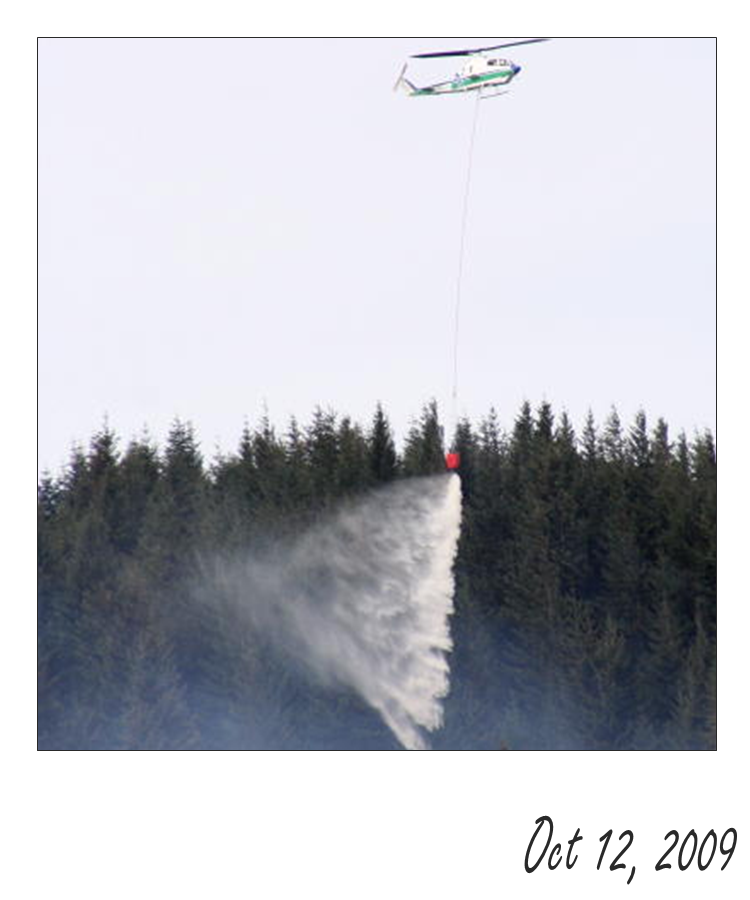
years ago we had a few wildfires that were very visible from our house.During the day we could watch as water and fire
retardant were being dropped from airplanes and helicopters. During the night we could see the glow of the
raging fire, which was on the next ridge line across from us.
A few
weeks ago Tony had a DNR (Department of Natural Resources) Fire Forester guy
come out to look at our place and let us know how we would fare if a wildfire
came through.The outcome of that visit
was the knowledge that we would be on our own.We were told that ground fire crews would not be sent out due to the steepness
and inaccessibility of the mountain ridge we live on.They may send out an aircraft to drop some
fire retardant on our house but that’s about it.On the positive side, the DNR guy did say
that we have a great start on the defensible space around our home and had the
right to stay and protect it.Before he
left he gave us a bunch of information on how to make the defensible space
around our home even better.
If you
are not sure what ‘defensible space’ means...it is an area around a structure
where fuels and vegetation are treated, cleared or reduced to slow the spread
of wildfire towards the structure. It
also reduces the chance of a structure fire moving from the building to the
surrounding forest.
Defensible space survivor (Source: napafirewise.org)
(Source: napafirewise.org)
In
addition to making sure we have a good defensible space, we also need to create
our own Wildfire Action Plan.This is so
our whole family will know escape routes, communication plans, emergency
meeting location, emergency contacts, etc.Here are a few good examples of Wildfire Action Plans...
After
the visit from the DNR Fire Forester guy, going thru all the paperwork he gave
us, a little extra research online, and talking about what we still need to do
around here to improve our defensible space...I’m learning very quickly that
fire is a very capricious thing.It can
find the weak link in your home’s fire protection scheme and gain the upper
hand because of a small overlooked or seemingly inconsequential factor.While we may not be able to accomplish all
fire safe measures, each will increase our home’s, and possibly our family’s,
safety and survival during a wildfire.
Yes,
of course I know a wildfire or any home fire for that matter is bad.But I think most people have the attitude of “it
will never happen to me”, I know I do.Which is why we are trying to change and have a FIRESAFE attitude.We have started off with the easiest and
least expensive actions.Beginning our
work closest to our house and we’re moving outward.We are continuing to work on the more
difficult items until we have completed them and can mark them off of the
to-do-list. To see a Wildland Fire Suppression Kit (this is on our to-do-list) that our friend made {click here}.
While fire insurance might
replace property destroyed in a fire, there is no insurance available to
replace human life.
8:29 am - 39 degrees out - clouds are moving in...
The last several days we have had
sunshine! The nice weather was needed after several weeks of rain and snow.
With this gorgeous weather, we have taken full advantage and have been busy outside
working.
Tony cut down some more trees
to help improve our defensible space around our home. A few years back we had a
DNR (Department of Natural Resources) Fire Forester guy come out to look at our
place and let us know how we would fare if a wildfire came through. The outcome
of that visit was the knowledge that we would be on our own. We were told that
ground fire crews would not be sent out due to the steepness and
inaccessibility of the mountain ridge we live on. They may send out an aircraft
to drop some fire retardant on our house but that’s about it. On the positive
side, the DNR guy did say that we had a great start on the defensible space
around our home and had the right to stay and protect it. {Click Here} to read
more about that visit.
Down came six small Alder
trees and one large Douglas Fir tree, and it took us two days to get it all
cleaned up...
...well almost all cleaned up.We still have the large rounds in the driveway that need to be cut up
and split into firewood.
Even though we are tired and
sore from working nonstop for the past several days to get the trees down and
cleaned up... progress feels good!
A few years after we moved up here, Tony had a DNR (Department of Natural Resources) Fire Forester come out to look at our place and let us know how we would fare if a wildfire came through. The outcome of that visit was the knowledge that we would be on our own. We were told that ground fire crews would not be sent out due to the steepness and inaccessibility of the mountain ridge we live on. They may send out an aircraft to drop some fire retardant on our house but that’s about it. On the positive side, the DNR guy did say that we had a great start on the defensible space around our home and had the right to stay and protect it. Before he left, he gave us some information on how to make the defensible space around our home even better.
If you are not sure what ‘defensible space’ means…it is an area around a structure where fuels and vegetation are treated, cleared or reduced to slow the spread of wildfire towards the structure. It also reduces the chance of a structure fire moving from the building to the surrounding forest.
We are very aware of the danger from wildfires, and so far, we have only been in various levels of ‘evacuation zones’ a handful of times – several times we had our rigs all packed and ready to go, and we have actually evacuated twice when the fires have gotten a little too close for comfort.
This wildfire last fall was less than two miles away from our house and we did end up evacuating.
Over the years, we have had a few wildfires that were very visible from our house. During the day we could watch as water and fire retardant was being dropped from airplanes and helicopters, and during the night we could see the glow of the raging fire, on the next ridge line over from us.
Last night we had another scare with a fire that was about 3/4 of a mile from our house. Usually when there is a fire, or visible smoke within 5-7 miles of us, our phones blow up with calls and texts. However, yesterday it had been raining hard all day, and it was foggy with low clouds, so no one saw the smoke or fire. It wasn’t until it got dark, the rain stopped, the clouds lifted a little, and then you could see the orange glow from the burning trees.
When we first saw the hillside on the ridge across from us ablaze, and we hadn’t heard anything about it, we went with assumption that no one knew about it yet and went into evacuation mode – sent a group message to our neighbors to inform them of the fire that was in close proximity, called 911, and started packing our rigs in case we needed to leave.
Within a half hour, Tony and Jack had their fire equipment pack and went to inspect the fire, we had our rigs packed and ready to go, and another neighbor had contacted DNR. That’s when we found out that the fire had started out as a planned controlled slash burn that had gotten out of control when the wind unexpectedly picked up to 30+ mph wind gusts which caused the burning slash piles to jump to the surround trees.
Thankfully they got the fire back under control, and no structures or people were hurt. But it was still a bit of a stressful night as this has been the closest fire to our house to date.
9:42 am - 35 degrees - snowing (but not sticking)... There
are so many projects going on right now and even more that need to be
done.This life style is definitely not
for the lazy.Even with a solid daily
effort, there always seems to be three more things that need to be done on top
of the handful of things we want to do.
One of
the things we’re (I really mean Tony – I’m just around on this one for ideas
and support) working on is the clearing of the defensible space {click here}
around our house which works its way into the pond area {click here} and the
new driveway / extra parking area.
The
defensible space and pond area are pretty high on our priority list.We had a very dry winter compared to previous
years and the rainfall for this year is already way down.We’re thinking the fire danger for this year
is going to be fairly high and start earlier than usual.In this case, we would rather be safe than
sorry.
While
Tony has been clearing the defensible space and pond area, we’ve been talking
about reworking the driveway.We’ve been
talking about this for several years now and we think we have finally decided
on the general area.This project is
going to be a major undertaking.There
will be a lot of dirt to be moved and a lot of base and top rock to be purchased.{More posts on the driveway to come.}
In the
meantime, this area needs to be cleared.Large trees that are within falling distance of the house are being cut
down, limbed, and placed into a “staging area” just to get them out of the
way.The underbrush needs to be cleared
out and burned along with the stumps and limbs from the trees.This is the phase that we are currently
in.
When
all the clearing is done, then the dirt work will begin to make everything look
pretty again.
2:17 pm - 53 degrees - gorgeous warm winter day... Back
in August Tony had a DNR (Department of Natural Resources) Fire Forester guy
come out to look at our place and let us know how we would fare if a wildfire
came through.{click here}Before he left he gave us a bunch of
information on how to make the defensible space around our home even better.
Going
through all the paperwork he gave us, a little extra research online, and
talking about what we still needed to do around our house, we decided to apply
for a permit to clear a dozen or so trees and underbrush.After numerous phone calls and emails, five
months later we have a wood permit in hand.This will give us our ideal defensible space around our home (and an
extra bonus of more sunlight in the winter months).
So in
addition to finishing up the screenings (yes we’re still working on that)
{click here}, Tony has now started to fall a few trees.
We finally did it! We moved our
driveway over and made a parking area that is big enough to turn a trailer
around. We have been wanting to do this for a while now, and I am so excited
that it's almost done – all we have left is to finish planting out all the dirt areas.
From the main driveway, you
were able to see down into our place, the house, the yard, the cars,
everything. In the dry summer months, when someone drove by or it got windy,
the dust would roll on down into our place. So with moving the driveway over, building
a burm across the old driveway entrance and planting it out, it will give us
that extra bit of privacy and hopefully keep the dust out.
Last fall, Tony roughed in the
new driveway and was able to get some base rock down before winter.
Then in early April Tony
started cutting down trees, this was originally to expand our wildfire
defensible space around the house {click here}, but it evolved into a much larger project... After a few of the trees came down and we picked up the mess, we walked around our driveway (new and old) and started tossing around ideas of how we wanted to get rid of the old driveway entrance, and just how everything would lay out and come together. Then Tony suggested that we could take some dirt from over here and put it over there and voila, we could have a really large parking area. I said let's do it!
A few weeks went by and then I came home to a big surprise! Tony was in the excavator and a friend was in a bulldozer and they were moving a TON of dirt! I was giddy with excitement that the driveway project was actually happening!
From the time Tony started moving dirt, it took 3 and a half days (over a week and a half time period) to complete the driveway and parking area project and since Tony was able to reuse the rock from the old driveway in the new parking area, we were able to save about $2500 because we didn't need to buy rock - I really loved that part! I could not be happier with how this project has turned out, it's even better than I anticipated. Now we just have to finish planting out all of the dirt areas.
New Parking Area
We can park cars/trucks - 6 wide, 2 deep.
Just above the row of boulders on the middle terrace, we planted some Everybearing Strawberries. I know we're taking a bit of a chance having the strawberries out in the open like that, but hopefully the deer will leave the majority of them alone and they will spread and creep around and down the boulder wall.
Everbearing Strawberries
About 6 feet behind the strawberries, is a row of Cascara trees, and right behind those are two rows of Redstem Ceanothus.
Cascara (Rhamnus purshiana)
Redstem Ceanothus (Ceanothus sanguineus)
Going up the back wall of the burm that blocks off the entrance to our old driveway, we have several rows of Redstem Ceanothus, followed by several roes of Western White Pine, one row of Rocky Mountain Maples, and two more rows of Western White Pines. On the very top we have a row of Cascara trees and below that, on the main driveway side, is a row of American Cranberries. We will be adding some more mature Vine Maples and maybe a few Noble Firs on the top to help block the view a bit more until everything else starts to grow up.
Western White Pine (Pinus monticola)
Rocky Mountain Maple (Acer glabrum)
American Cranberry (Vaccinium macrocarpon)
And finally back towards the house I built a stone retaining wall to make a flower bed where we planted some Kinnikinnick.
Kinnikinnick (Arctostaphylos uva-ursi)
Current Plant Count:
15 American Cranberries
14 Cascaras
26 Ceanothus'
50 Everbearing Strawberries
7 Kinnikinnick
15 Rocky Mountain Maples
43 Western White Pines
In addition to all of the baby plants we are putting in, we're also going to throw down more grass seed to help stabilize all of the dirt. I am so excited, I can't wait for everything to grow up.
9:40 pm - 72 degrees - scattered clouds with a slight breeze... Several
weeks ago we sent out our first load of logs on a self-loading log truck {click here}.And early this morning the self-loading
log truck (with the really nice driver) returned for the last load of logs (which left a few thousand pounds
shy of a full load – and yes, the trucking cost is the same regardless if it’s
a partial or a full load).
Unloading the trailer aka log dolly.
Everyone finds the
self-loading log truck fascinating.
Off to the mill he goes.
Logging
a small section of our property was not the intent of this project. Clearing a defensible space is {click here},
and we didn’t feel the need to remove any unnecessary trees.
Now
that Tony has finished removing all the necessary trees, the next step will be
to clean up the area... after we cut, haul, split and stack the pile of
firewood that is.
8:56 am - 62 degrees - beautiful day... While
we’re working on clearing the defensible space {click here} around our house
which works its way into the pond area {click here} and the new driveway/extra
parking area, a number of trees have had to come out.
For
the past several months, on nights and weekends, Tony has been falling,
limbing, and stacking logs – one pile to be hauled off to the mill and another
pile for firewood.
Yesterday
afternoon a self-loading log truck came up to haul off the first load of logs. We’ve seen log trucks loaded up but we’ve
never watched a self loader before, they’re definitely a world unto themselves.Half truck, half machine, a truly independent
aspect of logging.
After
the trailer, also known as a log dolly (which is hauled in a piggy-back
configuration), was unloaded and hooked up, the logs were able to be loaded on.
Loading
logs takes quite a bit of skill – maneuvering the large logs and getting them balanced
and placed just right on the trailer.It
was really interesting to watch.
Over
the bridge and thru the woods, off to the mill he goes.